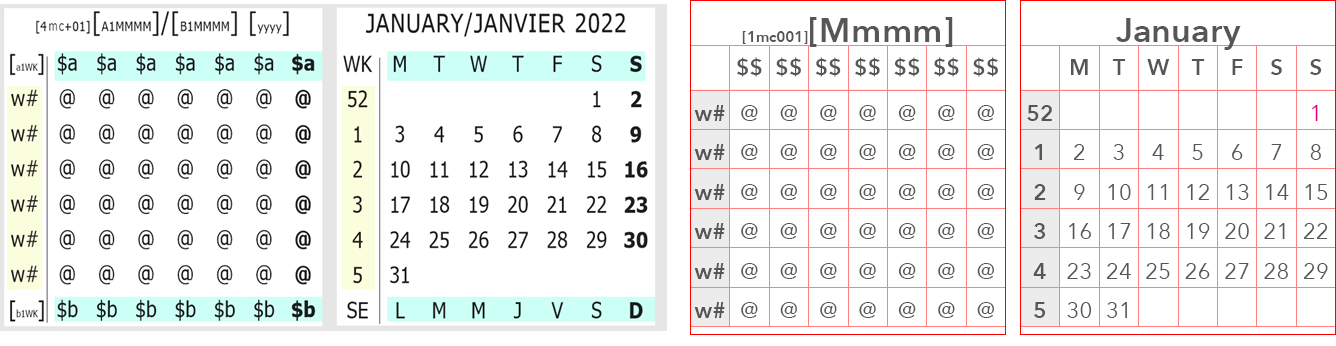
minicalendars placed in a single textbox, left, or in a table, right (InDesign only)
Mini-calendar tokens, and the corresponding mini-calendar script line property, are used to display mini-calendars.
QuarkXPress
When using QuarkXPress, all the tokens related to a mini-calendar must be located in the same textbox, as shown above left.
Minicalendar Token and Codes
With reference to the example above left, mini-calendar are made up of the following tokens and codes.
[4mc+01] |
This is the mini-calendar marker token.
This token does not display anything; It is used to determine the month and year of the current mini-calendar, interpret the various mini-calendar codes (such as @, $a or w#), as well as the reference date of any ordinary tokens placed inside the mini-calendar.
The base mini-calendar token can be augmented by a large number of mini-calendar token modifiers which can modify almost all aspects of the mini-calendar. |
$a and $b |
These are weekday headers, which are replaced by weekdays. If your script only uses one language, then you can replace $a by $$. |
w# |
These are the week numbers. |
@ |
These represent all the possible mini-calendar dates. |
Ordinary Tokens inside a Minicalendar
By tokens inside a mini-calendar, we mean tokens that are placed in the same textbox as, and after, a minicalendar marker token.
Ordinary tokens placed after the mini-calendar marker token use the first day of the mini-calendar’s month as the date corresponding to DayValue 1.
Use an Embedded Tokens Week Start modifier (:ws) to change this reference date to the beginning of the week containing the first of the month.
Topic 000143, last updated on 06-Oct-2026