void = List_SetValue(sListVarName, nIndex, sSomeTextValue)
➢This function only changes the value part of the string located at nIndex. The name and number part of the nIndex element remain unchanged.
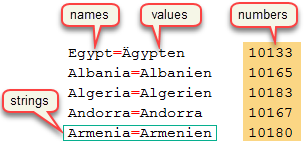
In the image, on the right, the various parts of a list are shown.
➢Each element of a list contains a string and an associated integer.
➢If the string contains an equal sign (=), then it is possible to access the text on the left as the name and the text on the right as the value.
Consider the macro code below, which adds some entries to a list and then calls various list functions to get back some information.
List_Clear(sListCountries)
// put some values in the list
List_Add(sListCountries, 'Egypt=Ägypten', 10133) // item 1
List_Add(sListCountries, 'Albania=Albanien', 10165) // item 2
List_Add(sListCountries, 'Algeria=Algerien', 10183) // item 3
List_Add(sListCountries, 'Andorra=Andorra', 10167) // item 4
List_Add(sListCountries, 'Armenia=Armenien', 10180) // item 5
// now get some information back from the list
sResult = List_GetValue(sListCountries, 5) // 'Armenien'
// make changes to the elements of the list
List_SetValue(sListCountries, 5, 'Arménie')
// read from item 5 again
sResult = List_GetValue(sListCountries, 5) // 'Arménie'
Creation and Destruction of Lists
When using lists, don't forget to use the function List_Create to create your list at the top of the macro, and then the function List_Destroy to destroy it at the end of the macro.
See also: list macro functions.
Topic 178370, last updated on 10-Oct-2026