The middle part of the moon lore rule editor is where you can set the options that will be used to determine if a given moon lore rule is true or not.
The options select dates and matching time intervals within those dates. Entering selects the whole entry date. Other modes can retain partial-day intervals. A group's Full Day box expands a nonempty match from that group to the whole day before it is combined with other groups. The separate Result is a full day option expands the combined result of the current tab; see below.
Moon Phases
Moon Periods |
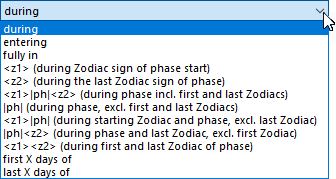
•The Entering setting selects the whole date on which the body enters a selected phase, period or sign. The Fully in setting removes these entry dates from the matching intervals. It can still include the partial departure date; use Full Day to expand a retained interval to the whole date. •The First X Days setting keeps the selected phase, period or sign's matching intervals on the current date only if that same selection has no matching interval X calendar days earlier. A retained entry date can be partial unless Full Day is checked. •The Last X Days setting keeps the selected phase, period or sign's matching intervals on the current date only if that same selection has no matching interval X calendar days later. A retained departure date can be partial unless Full Day is checked. •The During setting corresponds to exact times, from the time when the Moon enters a phase/period until the time it moves to the next phase/period, unless the Full day box is checked.
These periods can also be narrowed down to include or exclude the position of the Moon in the Zodiac and/or the first X or last X days of the period selected. The meaning of the |ph| and <z1> and <z2> used to define periods mixing a Moon phase/period with the position of the Moon in the Zodiac, can be seen from the diagram below.
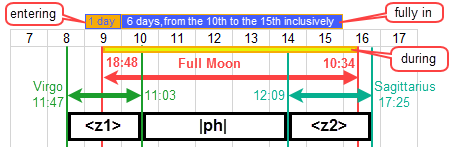
The periods defined by combinations of |ph| and <z1> and <z2>, such as the full Moon, Virgo and Sagittarius, above, are exact times, unless the Full day box is checked. |
Moon in Zodiac
Sun in Zodiac |
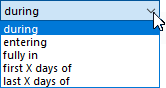
•The Entering setting selects the whole date on which the body enters a selected phase, period or sign. The Fully in setting removes these entry dates from the matching intervals. It can still include the partial departure date; use Full Day to expand a retained interval to the whole date. •The First X Days setting keeps the selected phase, period or sign's matching intervals on the current date only if that same selection has no matching interval X calendar days earlier. A retained entry date can be partial unless Full Day is checked. •The Last X Days setting keeps the selected phase, period or sign's matching intervals on the current date only if that same selection has no matching interval X calendar days later. A retained departure date can be partial unless Full Day is checked. •The During setting corresponds to exact times, from the time when the Moon/Sun enters a Zodiac sign until the time it moves to the next Zodiac sign, unless the Full day box is checked.
The Moon stays about 2 days and 11 hours in each Zodiac sign, on average. The number of civil dates touched depends on the entry time and the duration: a stay can span parts of four dates, for example from Monday evening to Thursday morning. |
Months |
You can specify as a condition that it only happen in certain month(s) or should never occur in certain month(s). |
Other Criteria |
You can specify as a condition that it only happen, or not happen, during a certain time of the day. For example, activities such as shopping or going to the dentist, can be set to only be allowed from 8am to 6pm. |
Result is a full day |
When Result is a full day is set on a tab, any nonempty combined matching interval on that tab is expanded to the whole day. This is not a one-minute minimum-duration test. Expansion is performed separately for Required and Exclusions, before the exclusion intervals are subtracted. A full-day Required result can therefore be shortened by exclusions; a full-day Exclusions result removes the whole date. |
Within a group, selected phases, periods, signs or months are alternatives. Across groups, the matching intervals must overlap: all active group conditions on a tab are combined. The Exclusions tab also combines its groups; it does not independently remove every interval matching any one of its groups. Its combined intervals are subtracted from the Required intervals.
For example, if Required matches 08:00–18:00 and the combined Exclusions match 12:00–14:00, the rule retains 08:00–12:00 and 14:00–18:00, for a total of 8 hours. With Result is a full day enabled only on Required, the result is instead the full day minus 12:00–14:00, for a total of 22 hours.
A group with no selected values is not tested. A time-of-day range of 0–24 imposes no restriction and is not a tested condition by itself. If a tab has no tested conditions, it produces no match: an empty Exclusions tab removes nothing, while an empty Required tab supplies no matching intervals.
The total duration remaining after these operations can be exported to Excel or used in a script with MoonLoreNumHours. That function adds the remaining intervals, adds a one-minute allowance once to their total, and truncates to a whole number of hours; see its topic for examples.
Topic 181290, last updated on 18-Apr-2020