Use the [ddd], [Ddd] or [DDD] day token to get a shortened version of the weekday name for the current date and current language.
All three tokens give the same result. The only difference is the capitalization.
➢Note that this token does not necessarily abbreviate the weekday name to 3 letters. It displays whatever shortened weekday translation you have supplied in the tokens manager. For each script you can additionally specify that you wish to only have a limited number of letters (see the length of [ddd] option).
So, on Tuesday, October 12th, in English, the result may be:
•[ddd] = tue
•[Ddd] = Tue
•[DDD] = TUE
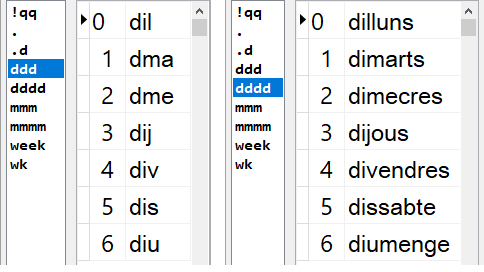
the [ddd] token in Catalan which does not follow a "first N characters" rule
The reason why we say the result may be, is that the above tokens are mixed source tokens. Q++Studio will decide, based on the current date, which day of the week it is, but it will then look for the translation that you supplied for 'Mon', 'Tue', 'Wed' … in the current language.
Since you specify the translations, you have total freedom. For example:
•You may decide that in Swedish the shortened weekdays are not the first 3 letters (as in English), but the first 4 letters.
•For Catalan, as all weekdays begin with "di" (dilluns, dimarts, dimecres, dijous, divendres, dissabte, diumenge), it is customary for the weekday abbreviations not to follow an exact "first n characters" rule (dil, dma, dme, dij, div, dis, diu).
Similarly you can easily create a descendant language based on English, where the [ddd] tokens are replaced by only the 2 first letters of the weekday name (although in this case it would be simpler to use the length of [ddd] GridOption).
See also: shortened month name, day tokens.
Topic 000081, last updated on 18-Oct-2026